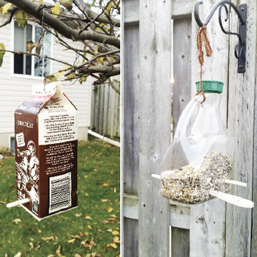
Some of the best learning moments don’t look like learning at all. This easy DIY STEM activity turns everyday materials into a backyard bird feeder and your kids into curious observers. It’s part craft, part science, and all about slowing down to notice what’s happening just outside your window.
What’s Going On:
You can nurture local wild bird populations and have a chance to see them close up, too! A mix of seeds will bring a variety of birds to your feeder – from sparrows to cardinals, and robins to chickadees! Keep track of the birds you observe using the bird tracking chart below.
Do you observe patterns of behavior? What time of day do you see the most birds? What species do you observe? Do the same birds and their families keep coming back?
You can use the free Audubon North American
Bird Guide to help you identify your birds:
https://www.audubon.org/bird-guide
Or, you can get their free Bird Guide app:
Now Try This:
Become a birdwatcher, and contribute to a Citizen Science project! Birdwatchers are one of science's most vital sources of data. Data from birdwatchers helps scientists get a broad picture of how the environment is doing.
Changes in bird migrations, populations, and behavior can point to changes in insects, habitats or predator populations.
Next February, you can participate in The Great Backyard Bird Count. It's a global bird count organized by the Audobon Society and the Cornell Lab of Ornithology:
https://www.audubon.org/community-science/great-backyard-bird-count
If you're interested in birdwatching all year long, you can get a yearly membership to join Project Feederwatch: https://feederwatch.org
Fun Facts:
Backyard Birds
What You Need:
Safety note: Ask your adult helper to help you with the steps that involve cutting.
What You Do:
STEP 1: Poke holes in your container where you want your perches to be. You need two holes for each perch because each stick will go through both sides of the container.
STEP 2: Ask your adult helper to help you cut a small hole above each perch so the birds can reach in to get the seeds. The holes should be big enough that a bird's beak can fit inside, but not so big that birds can climb inside. Make sure there are no sharp, jagged edges that could hurt the birds.
STEP 3: Take your bird feeder outside and fill it with bird seed. Make sure the top of the feeder is closed so the seeds stay dry.
STEP 4: Use string to hang your bird feeder from a branch or fence near your home. Try to position it where you can see it from a window.
STEP 5: Observe what kinds of birds visit your feeder. Remember to refill it with seeds regularly!
Science humor:
Q: Why do birds fly south?
A: Because it is too far to walk!
Mad Science of Southern Alberta knows how to make science fun for kids. Learn more at calgary.madscience.org.







Calgary’s Child Magazine © 2026 Calgary’s Child