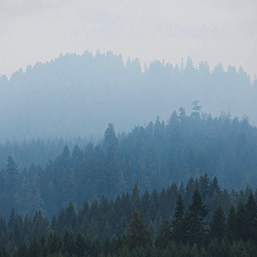
When smoke from a wildfire (such as a forest fire or grassland fire) enters a community, it can cause problems for the people who live there. The biggest health risk comes from small particles in the smoke. These particles can get in your eyes, breathing (respiratory) system, and bloodstream.
This can cause:
If you have a heart or lung problem, these small particles can make it worse.
Who is most at risk for health problems from wildfire smoke?
You might have problems earlier and at lower smoke levels if you:
Smoke can also be harmful to pets. Try to keep your pets inside as much as possible and make sure they have lots of water. If your pet has trouble breathing, contact your vet.
If smoke is a problem where I live, what can I do to lower my health risk?
If smoke is a problem in your community, stay inside as much as possible and keep all windows and doors closed. Here's what else you can do to keep your indoor air clean:
Can wearing a mask help protect me from smoke?
Wildfire smoke is a mixture of gases, particles, and water vapor. Particulate matter, particularly fine particulate matter, is the main public health concern with wildfire smoke. Like other air quality issues, a multi-layered approach is recommended to reduce the health effects of wildfire smoke. Personal protective equipment like respirators (such as N95, KN95, or P100) may be used to reduce exposure to wildfire smoke, but are most effective when used as part of a multi-layered approach. Other important layers include staying indoors with doors and windows closed as long as temperatures remain comfortable, cleaning indoor air, and minimizing outdoor activities.
Respirators are effective for filtering fine particulate matter (as small as 0.3μm), but do not protect the user from gases in wildfire smoke. Proper fit and use are critical for respirators (such as N95, KN95, or P100) to provide the level of protection expected. Users should follow the manufacturer's instructions for use, including performing a "seal check" to determine proper fit. People at increased risk of adverse effects from wildfire smoke, such as those with heart or lung problems or older adults, should consult with their health care professionals before using a respirator, as using a respirator can make breathing more difficult.
When a well-fitting respirator is not available, a high-quality medical mask (such as an ASTM-certified mask) may provide some limited protection against wildfire smoke. However, the overall benefits are uncertain, as the harmful particles are so small that they can go around or through these masks.
Can I still be active when there's wildfire smoke in the air?
Pay attention to the local air quality health index (AQHI). Adjust your activities according to the AQHI messages. Move outdoor activities indoors, and keep your indoor air as clean as possible. Reschedule or cancel outdoor events (such as sports or competitions) if smoke levels are too high.
When you're outside, don't do any heavy activity or exercise. Heavy activity and exercise can make you breathe ten to 20 times more than you do while you're resting. Stop or slow down if what you're doing makes you cough or feel tired.
Drink lots of water to stay hydrated. This will keep your nose and mouth moist, which makes it easier to breathe. This is important when you're inside and outside.
When there is a lot of haze in the air, don't let your children play outside for a long time.
What if I start to feel unwell?
When there's wildfire smoke where you live, pay close attention to your health, especially if you have heart or lung problems. Take all your regular medicines. It's a good idea to have a week's supply of medicine with you. Do everything your healthcare provider told you to do, and contact your healthcare provider if you have any health concerns, even if you don't have heart or lung problems.
If you have chest tightness, chest pain, shortness of breath, or another health emergency, call 911 or go to the nearest emergency department right away.
For 24/7 nurse advice and general health information, call Health Link at 811.
This material is not a substitute for the advice of a qualified health professional. This material is intended for general information only and is provided on an "as is, where is" basis. Although reasonable efforts were made to confirm the accuracy of the information, Alberta Health Services does not make any representation or warranty, express, implied, or statutory, as to the accuracy, reliability, completeness, applicability, or fitness for a particular purpose of such information. Alberta Health Services expressly disclaims all liability for the use of these materials, and for any claims, actions, demands, or suits arising from such use.
See our related articles:





Calgary’s Child Magazine © 2026 Calgary’s Child