
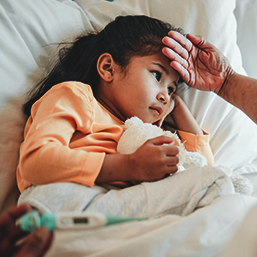
Fever is a common and normal response to infection. Considering that many children (especially preschoolers) have up to ten viral infections per year and that a lot of these infections cause fevers, parents need to be very familiar with fever management.
Keep in mind that it is not the fever itself that is harmful or needs to be treated, but the symptoms of unwellness and dehydration that do. Knowing how to take your child’s temperature accurately, when and how to treat a fever, and signs and symptoms that would prompt you to seek medical help are important parenting skills.
In general, any temperature above 38°C (100.4°F) is considered a fever. Fevers can get as high as 41.1°C (106°F), but how high a fever gets is not an indication of how serious your child’s infection is. If your child still has a fever after three full days, they should be seen by a medical professional as they may have an infection which requires investigation and treatment. Teething can cause a mild increase in your child’s temperature, but not generally over 38°C.
Infants under three months of age who have any degree of fever at all have a much higher chance of having a serious infection than older infants and children. For this reason, they must be taken without delay to an emergency department or urgent care centre for assessment and investigation, even if they do not seem sick.
There are several types of digital thermometers you can use to check your child’s temperature – ear (tympanic), armpit (axilla), mouth (oral), forehead, and bum (rectal). The most accurate is the rectal thermometer and these are highly recommended for use in infants, especially those under three months of age. Check out myhealth.alberta.ca for clear instructions and videos on how to use these thermometers. For toddlers and older children, digital ear or armpit thermometers are good, practical, and accurate choices.
When children are ill and have a fever, they are often miserable and don’t feel like eating or drinking. Encouraging them to drink is more important than getting them to eat. Keep track of their urine output and call Health Link at 811 for advice if:
Treating your child with fever medication such as acetaminophen (like Tylenol®) or ibuprofen (like Advil® or Motrin®) can reduce discomfort and make them more likely to drink enough. If your child is under the age of six months, ibuprofen should not be given because of its effect on their immature kidneys and liver. When giving fever medication, choose the dose based on your child’s weight, not their age, and do not give more doses per day than is recommended on the bottle. If in doubt, call 811 for advice.
If your child has any of the following symptoms, you should call 911 to have paramedics assess and then take your child to the emergency department:
Children should be taken to an urgent care centre or emergency department if they will not stop crying, are very cranky or irritable for a long time, or if you notice either a bruise-like rash or purple spots on their body.
Febrile (fever) seizures happen in two to five percent of children under the age of five. They are very unlikely to cause any harm to your child, but they can be quite frightening and require a medical assessment, even if no tests need to be done. Sometimes they will happen at the beginning of your child’s illness when their temperature is only starting to rise, so you may not even realize that they are getting sick. Around 30 to 50 percent of children who have had one febrile seizure will have another one within a year.
When your child has a seizure, they become unresponsive and have rhythmic jerking or shaking of their arms and legs. Their eyes may roll back and they may stop breathing for a few seconds, vomit, urinate, or pass stool. If you can, roll them onto their side and try to protect them from hurting themselves. After the seizure, they may be sleepy and confused but their behavior should return to normal within a short period of time.
If the seizure lasts less than three minutes, you should take your child to an urgent care centre or the emergency department for a medical assessment. If the seizure lasts longer than three minutes, you should call 911 so that paramedics can manage the seizure if needed and take your child to the emergency department for assessment.
Now it’s time to take a big breath, check that your thermometers are in good working condition, and know that you are well prepared for your child’s next fever!
Dr. Cathryn Kuzyk has been a family physician for over four decades and is loving being grandma to six.
See our related articles:






Calgary’s Child Magazine © 2026 Calgary’s Child