
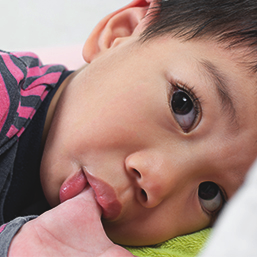
Thumb- and finger-sucking are completely normal in babies and young children. Sucking is soothing. It helps children calm themselves, fall asleep, and manage big feelings – and for some kids, that thumb becomes a very reliable little friend.
So when parents ask me, “When do I need to worry about thumb-sucking?” my answer is usually, “That depends.” The American Academy of Pediatric Dentistry recommends children wean from all oral habits by age three. The bigger question is when is right for your child and how to help them stop.
When does thumb-sucking start affecting the teeth?
Not every thumb-sucking habit affects the teeth in the same way. What matters is how frequently a child sucks, how forcefully they suck, and, especially, how long the habit continues.
When thumb- or finger-sucking persists, we can start to see changes in the developing teeth and jaws. The upper front teeth may begin to tip forward, the lower front teeth may tip backward, and sometimes a space develops between the upper and lower front teeth when the child bites together. This is called an open bite.
The shape of the upper jaw can also be affected with a prolonged habit, turning into a V rather than the more ideal U.
The good news is that young children are still growing and some dental changes can improve naturally once the sucking habit stops. Generally, though, the earlier we can eliminate a persistent habit, the more opportunity there is for the teeth and jaws to normalize as the child grows.
As a pediatric dentist, I start paying closer attention to a persistent thumb or finger habit around age three.
But knowing that it would be ideal to stop and actually getting a three-year-old to agree to stop are two very different things.
Your child needs to be ready
This is probably the most important advice I give parents.
You can’t force someone to give up a habit they aren’t ready to give up – particularly when the object of that habit is permanently attached to their hand.
I often compare stopping thumb-sucking to potty training. Parents can provide encouragement, tools, and opportunities for success, but ultimately the child has to participate.
If your child becomes very upset whenever you mention stopping, secretly sucks their thumb as soon as you leave the room, or you find yourself constantly saying, “Thumb out!” it may not be the right time.
Instead, start planting the seed.
You might say, “As you’re getting bigger, we’re going to start helping your thumb stay out of your mouth so your big-kid teeth have lots of room to grow.”
Keep it positive. Avoid teasing, embarrassment, or punishment. We want children to feel proud of becoming ready to give up the habit, not ashamed that they had it in the first place.
Try a 30-day challenge
When a child tells me they’re ready, I like to make stopping very visual.
Print out a calendar and create a 30-day thumb-sucking challenge.
Every successful day earns a sticker. The child gets to put it on the calendar themselves so they can actually see their progress.
You can add a small reward after each successful week and a bigger reward at the end of the 30 days. The rewards don’t have to involve buying things. Maybe your child chooses dinner on a Friday night, gets a special date with a parent, chooses the family movie, or earns another privilege that feels exciting to them.
The important thing is that the focus stays on success, not failure.
If there is a slip-up, don’t make a big deal about it. Habits are hard to change. Encourage them and keep going.
Give the thumb a reminder during the day
For many children, thumb-sucking is almost automatic. They may not even realize they’ve put their thumb into their mouth.
A Band-Aid® wrapped around the thumb can work wonderfully as a simple daytime reminder.
The Band-Aid® isn’t there to physically prevent sucking. It just feels different and gives the child that little cue: Oh right – I’m trying not to do that anymore.
Some children enjoy choosing their own colorful bandages, which gives them another bit of ownership over the process.
Nighttime is usually the hardest
Daytime is one thing. Sleep is another.
Children who have sucked their thumb to fall asleep for years often do it completely unconsciously at night. Telling them not to do it isn't particularly helpful – they're asleep!
This is where a gentle physical barrier can help.
You can put a sock over the hand and secure it safely over the pyjama sleeve, use pyjamas with fold-over hand coverings, or even sew the end of an old pyjama sleeve closed.
This isn't intended as punishment. It's simply a physical reminder that interrupts the automatic thumb-to-mouth movement while the child develops a new way of settling themselves to sleep.
I also encourage parents to think about what can replace the comfort of thumb-sucking. A favorite stuffed animal, cuddling with a blanket, listening to music, or having a slightly longer bedtime cuddle may help during the transition.
What if it's just not working?
Then stop trying for a while.
This is the part parents sometimes find surprising.
If you've tried the calendar, reminders, and nighttime strategies and your child can't get past a couple of days – or the whole thing has turned into a nightly battle – put it aside.
Come back to it in a month or two.
Just like potty training, sometimes a child who absolutely refuses one month decides a few months later that they're ready. Once the motivation comes from the child instead of the parent, the process can become dramatically easier.
If your child is continuing to suck their thumb or fingers beyond age three, mention it to your dentist. Your dentist can look at whether the habit is actually changing your child's bite and help determine how aggressively you need to address it.
Ultimately, our goal isn't simply to get the thumb out of the mouth.
It's to help a child successfully give up something that has provided comfort for a long time – without turning it into a source of shame, anxiety, or conflict.
A little patience, plenty of encouragement, and good timing can go a very long way.
Dr. Kari Badwi is a pediatric dentist.
See our related articles:







Calgary’s Child Magazine © 2026 Calgary’s Child