
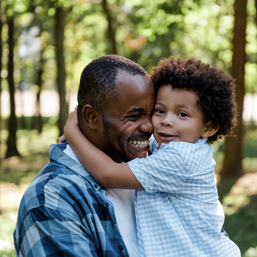
Empathy is an important social and emotional skill that helps children understand how others feel and to respond with kindness and compassion. As children work to develop empathy, they are better able to build friendships, resolve conflict, solve problems, and participate positively in their community. Empathy is something that grows over time as children develop, which means that parents can play a key role in helping their child learn and practice this skill in everyday moments. Just remember, as an adult you have a fully developed brain full of perspective-taking, emotional language, and understanding. As your child learns empathy there may be moments where they respond in a way that does not align with your more developed understanding of what it means to be kind and thoughtful. It will take patience and understanding as you support your child in learning about empathy through these small moments of daily practice.
Infants can often pick up on the “feelings” around them. When another baby cries, this can make them cry as well, even though they aren’t quite sure why. At this stage, infants are reacting to emotional cues rather than understanding another person’s feelings.
Parents and caregivers can respond quickly and supportively to their emotions. Give them cuddles, label how they feel, help them re-engage with a favorite toy or book. These basic responses are the foundation to a regulated system and an emotionally intelligent brain. We learn to respond to others by being responded to by caregivers.
Toddlers will often have a basic understanding of emotions. They will feel upset when a peer is crying, may offer things like a toy or a hug. At this stage they are displaying empathy based on what has been modelled to them or what they have experienced. They are learning by watching how the adults around them respond to each other.
Parents and caregivers can support toddlers by labelling and talking about different emotions. For example, “Oh, your friend looks sad – I can see tears in their eyes. Maybe we can help them by giving the toy back”. This helps toddlers to recognize emotions and practice how to respond.
Preschoolers will start to imagine and understand the emotions of others. They will display empathy through actions, often based on what is modelled for them. They are more able to take coaching from adults on how to support others. You might see empathy through actions such as comforting a friend, helping someone who is sad or hurt, or including a peer in play.
Parents can help by coaching children through different social situations. For example, you might ask questions like, “How did your friend feel when that happened?” You can also use stories and movies to help expand their emotional language. Point at character’s faces and ask how they are feeling. Talk about what happened that made them feel that way. Coach their social skills so they know how to respond to others. The more words your child has for understanding and describing how they feel, the more successful they will be in responding to the emotions of others.
School-aged children are becoming better able to understand other’s thoughts and feelings and situations become more complex. This can look like understanding different viewpoints from their own or recognizing that people might feel differently about the same situation. You may see children standing up for one another or working together to solve problems. Different themes such as fairness and kindness tend to be more visible in everyday interactions.
Parents are more easily able to have conversations around real life situations like conflicts with friends or hard situations that are occurring at school. If your child is struggling with a peer, you can help by practicing thinking about how others might feel, and what a kind, respectful solution might look like.
Teenage years demonstrate a continued growth of empathy as they develop stronger reasoning skills and social awareness. Social relationships become much more complex and can involve tricky social and emotional issues. Teens may also begin to show concern and care for community issues and fairness on a more universal scale.
Parents can continue supporting empathy by having open conversations, encouraging teens to listen to different perspectives, and supporting opportunities for helping others through volunteering or community involvement.
When children grow up in environments where their feelings are recognized and kindness is valued, they learn that their actions can make a positive difference. With practice and consistency, these small everyday moments help children develop empathy in a way that impacts their life in many positive ways.
Ashlee and Lisa are child psychologists who created KidsConnect Psychology as a place for children and families to access tools, supports, and therapy. Check out our website for digital downloads, parenting tool kits, information about our parent counselling, school consultations, daycare consultations and more! kidsconnectpsychology.com. Follow us on Facebook and Instagram at KidsConnect Psychology.







Calgary’s Child Magazine © 2026 Calgary’s Child